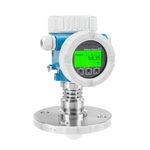
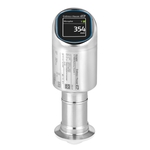
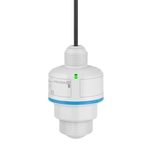
Continuous level measurement is essential for inventory control, process reliability, and operational safety in industrial tanks and silos, where a wide variety of liquids and bulk solids are stored and processed.
The Time-of-Flight measuring principle provides a reliable solution for continuous level monitoring. It operates by emitting ultrasonic or radar pulses that are reflected at the surface of the medium and received back by the sensor. The period of time between sending and receiving is used to calculate the distance to the surface. If the tank geometry is known, the level can be determined with high accuracy.
Ultrasonic waves are mechanically generated via piezoelectric elements and reflect due to density differences between air and the medium. Radar waves, on the other hand, are electromagnetic and reflect based on changes in the medium’s relative dielectric constant (dc value). Depending on the application, radar signals can be transmitted freely into the tank or guided along a probe.
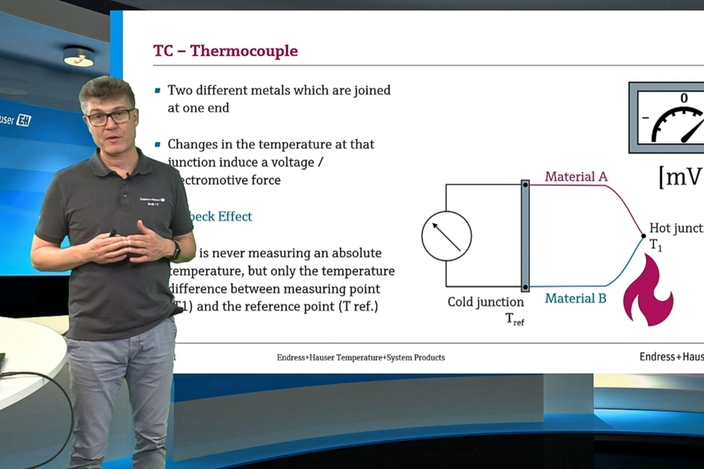
Watch the video to learn how the measuring principle Time-of-Flight works.
Advantages of Micropilot and Levelflex at a glance
- Continuous level measurement for liquids and bulk solids
- Reliable performance regardless of foam or turbulence
- Non-contact measurement minimizes wear and maintenance
- Suitable for demanding environments with high pressure, temperature, or steam
- Flexible installation options with free-space or guided wave radar
The most varied media are filled into and drained from storage tanks every day. Examples are potable water, fruit juices, oils and fuels, acids, brines or also solids like gravel, plastic pellets or powders. Since these media can have completely different properties, there are different measuring principles to detect them. For example, the continuous level measurement of liquids or bulk solids according to the Time-of-Flight method.
Around 1910 Alexander Behm succeeded in locating objects by means of reflected sound waves. The so-called echo sounding is the principle of ultrasonic measurement. As early as 1886, while working on the experimental evidence of electromagnetic waves, Heinrich Rudolf Hertz discovered that radio waves were reflected by metallic objects. This provided the basis for the measurement according to the microwave or radar principle. Let's have a closer look at how this measuring method works.
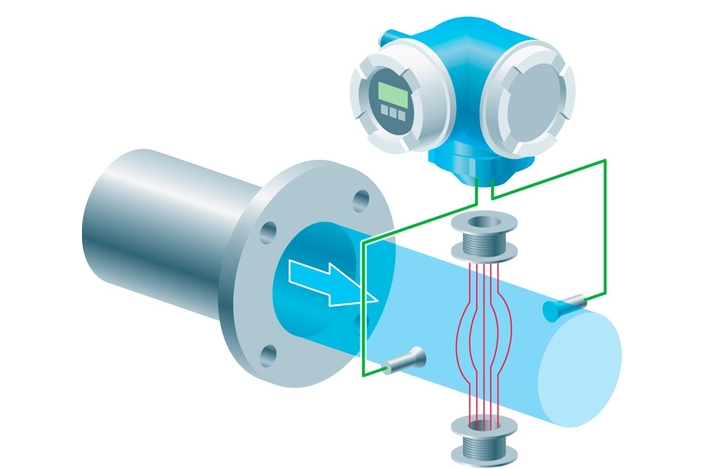
Time-of-Flight instruments continuously detect the level in tanks and silos. Ultrasonic or radar pulses are emitted, reflected on the medium surface and received again by the sensor. The distance between the instrument and the surface of the product can be calculated by measuring the Time-of-Flight. Ultrasonic waves are mechanical waves. Ultrasonic pulses are generated piezoelectrically and reflected on the medium surface by the density change between air and the medium.
The period of time measured and analyzed by the instrument between sending and receiving the pulse is a direct measure for the distance between the sensor membrane and the medium surface. Microwaves or radar waves, however, are electromagnetic waves. Radar pulses are generated electromagnetically and reflected on the medium surface by the change of the dielectric constant. The high frequency radar pulses can be let along a rod to the medium or they can be emitted free in a tank.
The Time-of-Flight measurement, demonstrated here by the example of free emitted radar pulses works both in liquids and solids. The emitted pulses are reflected from the medium surface and detected by the instrument. The Time-of-Flight of the pulse determines the distance between the transmitter and the surface using the known propagation of speed. In case of radar pulses, it is the speed of light.
Taking the height of the tank into consideration, the level can easily be calculated. Endress+Hauser Time-of-Flight instruments are measuring the level even in high pressures and temperatures applications, in different vapors, or on aggressive media, with turbulent liquid surfaces or with foam at the liquid surface. We have the right solution for any application. Endress+Hauser.